
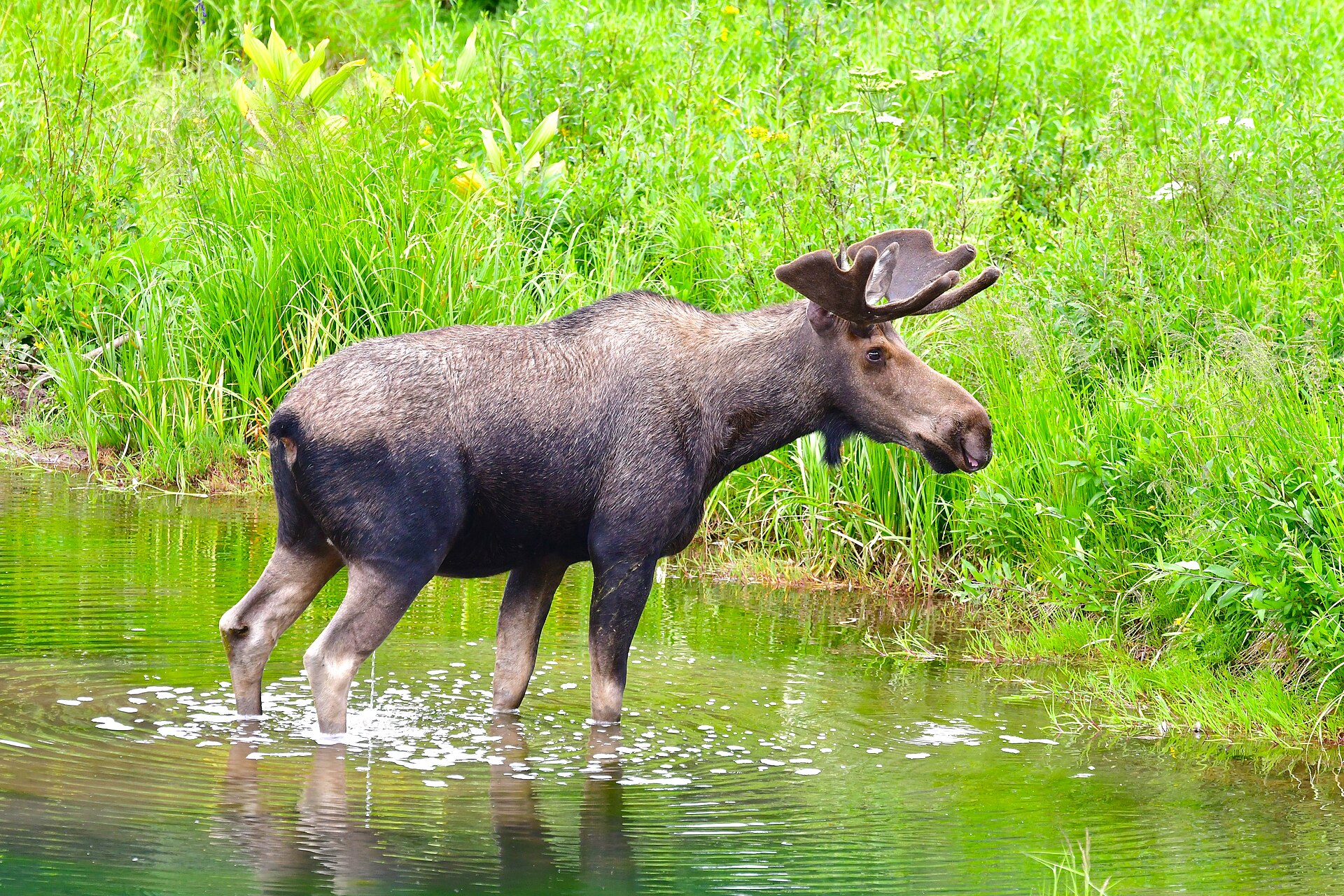
Why a Rangefinder Belongs in Every Moose Hunter’s Pack
Moose country lies to the eye. A bull standing across a muskeg looks like an easy 150-yard shot until the laser says 260. A cow feeding at the far edge of a cutblock looks impossibly far until the readout says 180. In the flat, featureless terrain where moose live — bogs, burns, frozen lakes, wide river bottoms — there are almost no reference points for judging distance, and human beings are notoriously bad at estimating range past 100 yards without them.
That matters because a misjudged 40 yards at 250 can turn a clean broadside shot into a wounded animal or a clean miss. Moose are big, but their vitals are still a target measured in inches, and most moose cartridges drop several inches between 200 and 300 yards. Knowing the exact distance removes the biggest variable in the shot equation. For bowhunters the stakes are even higher: at 40 versus 55 yards, the arrow’s trajectory is a different world, and there is no room for guessing.
A modern laser rangefinder weighs about as much as a granola bar, costs less than a tank of gas to moose camp in its budget forms, and answers the distance question in a quarter of a second. If you are putting together your kit, read it alongside the ultimate moose hunting gear checklist and the binocular guide — the rangefinder is the optic you use after the binocular finds the moose.
As an Amazon Associate, Moose Mulitia earns from qualifying purchases.
What to Look for in a Moose Hunting Rangefinder
Realistic range: game ratings, not reflective ratings
Every rangefinder advertises a big maximum-range number — 1,400 yards, 1,700, 2,000. That number is measured against a reflective target, like a road sign. What matters for hunting is the “deer” or “game” rating: how far the unit reliably ranges a non-reflective animal hide. A 2,000-yard rangefinder might only reach 1,000 yards on deer-sized game, and a 1,400-yard unit might reach 900. For moose, that is still plenty — the vast majority of moose are shot well under 300 yards — but buy with the game rating in mind, not the headline number. Anything rated to at least 600–800 yards on game covers every ethical moose shot you will ever take.
Magnification: 5x to 7x is the sweet spot
Rangefinders typically offer 4x to 7x magnification. More magnification makes it easier to hold the reticle steady on a distant bull and to pick him out of brush, but it also magnifies hand shake. For moose hunting, 6x is the comfortable middle ground; 7x is nice for open country like Alaska’s tundra or the prairie parklands, and 5x keeps the image steadier in thick timber. Anything in the 5–7x range works. Below 5x, precisely placing the beam on a moose’s chest at 300 yards gets fiddly.
Angle compensation: non-negotiable in hill country
Moose live in mountains as well as muskeg. In Alaska, British Columbia, and parts of Newfoundland, shots angled steeply uphill or downhill are routine, and gravity only acts on the horizontal component of the bullet’s flight. A 300-yard line-of-sight shot at a steep downhill angle might have a true ballistic range of 260 — hold for 300 and you shoot high. Every rangefinder worth buying for moose country has an angle-compensated mode (Vortex calls it HCD, Leupold calls it TBR, Bushnell calls it ARC, Sig calls it AMR). They all do the same job: give you the shoot-to range, not the line-of-sight range. Make sure the unit you buy has it, and hunt with it turned on.
Display readability in low light
Moose move at dawn and dusk, which is exactly when cheap black-LCD displays wash out or disappear against a dark animal. Red OLED or TOLED displays stay readable in failing light, and the best units auto-adjust brightness. If you hunt the fringes of the day — and you should — prioritize a red illuminated display over a standard black LCD.
Durability, weather sealing, and battery
Moose season means rain, wet snow, and freezing mornings. Look for genuine waterproofing (not just “water resistant”), rubber armor, and a common battery type — nearly all hunting rangefinders run on a single CR2 lithium cell, which performs well in the cold and lasts thousands of actuations. Carry a spare in an inside pocket; cold kills batteries, and a dead rangefinder on day six of a fly-in hunt is dead weight.
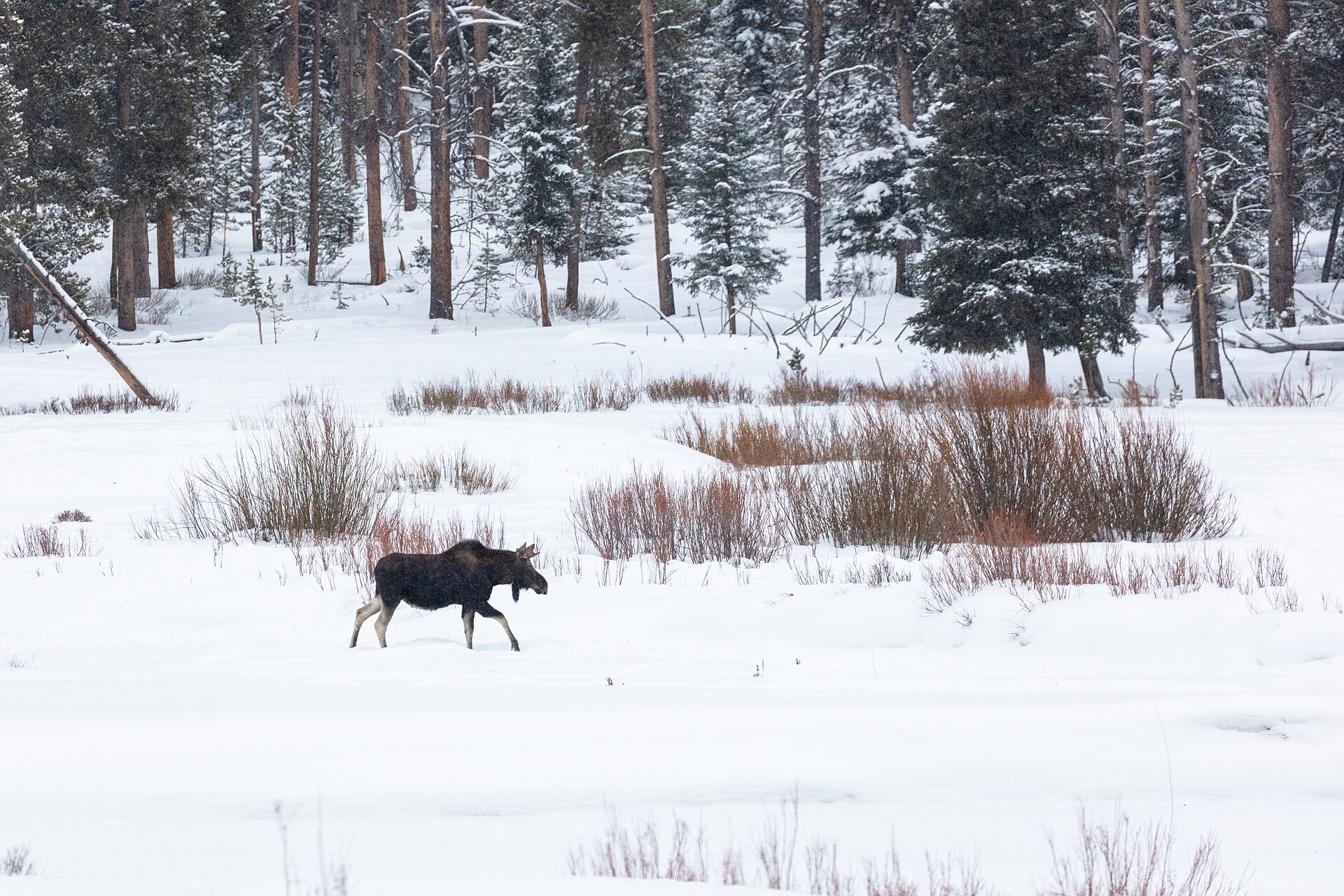
The Best Rangefinders for Moose Hunting in 2026
Best Overall: Vortex Diamondback HD 2000
The Diamondback HD 2000 is the rangefinder equivalent of a good all-around moose rifle: it does everything well enough that most hunters never need more. The 7×24 optic with Vortex’s HD glass is genuinely pleasant to look through — a real step up from budget units — and 7x magnification helps at the longer sightlines of open moose country. Maximum range is 2,000 yards on reflective targets, 1,800 on trees, and 1,400 on deer-sized game, which is far beyond any shot you should take at a moose but gives the laser plenty of headroom for fast, confident readings at real hunting distances.
It has both of the ranging modes that matter: HCD (Horizontal Component Distance) for angle-compensated shoot-to ranges and LOS (line of sight) for raw distance, plus Normal and Last target modes for picking a bull out of foreground brush. The red OLED display is easy to read at first and last light, and scan mode gives continuous readings while you pan. At 7.6 ounces and just over 4 inches long it rides fine in a chest harness next to your binoculars, and it is tripod adaptable for long glassing sessions. Vortex’s unconditional VIP warranty — repaired or replaced, no receipt, no questions — is the best in the business and matters on gear that lives a hard life. Street price is typically around $300, which makes it the value king of the full-feature class.
Specs: 7x24mm · 2,000 yds reflective / 1,800 trees / 1,400 game · HCD + LOS modes · red OLED · 7.6 oz · CR2 battery
Best Value: Leupold RX-1400i TBR/W Gen 2
If the Diamondback is the all-arounder, the RX-1400i is the thinking hunter’s bargain. Its headline feature is TBR/W — True Ballistic Range with Wind — which goes beyond simple angle compensation and calculates an actual 10-mph wind hold out to 800 yards. That is technology that used to live only in $500+ units, and it is genuinely useful when a crosswind is pushing across a cutblock. Bowhunters get Leupold’s Flightpath mode, which calculates the arrow’s trajectory and flags potential obstructions on angled shots.
The trade-offs are honest: 5x magnification instead of 6 or 7, a 1,400-yard reflective rating (1,200 on trees, 900 on deer), and a polymer housing rather than aluminum. None of that matters much for moose — 900 yards on game is triple the distance of a long moose shot, and at 5.1 ounces it is one of the lightest full-featured rangefinders made. The red TOLED display is bright, and it runs on a CR2. At around $200 with Leupold’s lifetime guarantee, it is the easiest recommendation on this list for a hunter buying their first serious rangefinder. Pair it with a solid moose rifle scope and the distance question is solved for the life of the optic.
Specs: 5x21mm · 1,400 yds reflective / 1,200 trees / 900 game · TBR/W + Flightpath · red TOLED · 5.1 oz · CR2 battery
Best for Ballistics and Tech: Sig Sauer Kilo1600
Sig’s Kilo line built its reputation on one thing: ranging speed. The Kilo1600’s HyperScan mode updates four times per second while you sweep across terrain, and its LightWave DSP engine is among the fastest at returning a reading on a dark, non-reflective target — exactly the problem a black moose hide presents at dusk. Maximum range runs 2,000 yards reflective, 1,200 on trees, and 1,000 on deer, through a 6×22 monocular with SpectraCoat anti-reflection coatings.
The transparent red OLED display with automatic brightness adjustment is excellent in changing light, and AMR (Angle Modified Range) handles the uphill-downhill math. The standout trait for backcountry moose hunts is the size: 5 ounces in a compact polymer housing that disappears into a pocket. The BDX-capable version can also talk to Sig’s Bluetooth-enabled scopes and feed ballistic solutions straight to an illuminated holdover dot — overkill for most moose hunting, but a nice glimpse of where the technology is going. If you hunt big, dark-timber country where getting a fast reading on a barely-visible animal is the whole game, the Kilo1600 earns its place.
Specs: 6x22mm · 2,000 yds reflective / 1,200 trees / 1,000 game · AMR + LOS · red OLED · 5 oz · CR2 battery
Best Mid-Range All-Rounder: Bushnell Prime 1700
Bushnell invented the consumer laser rangefinder, and the Prime 1700 shows the company still knows the hunting market. The 6×24 all-glass optical system is a genuine highlight at this price — Bushnell claims up to twice the light transmission of competing units, and in side-by-side use the image is noticeably brighter than budget rangefinders at dawn. Maximum range is 1,700 yards reflective, 1,000 on trees, and 700 on deer, with ranging accuracy of ±1 yard and updates four times per second in scan mode.
ARC (Angle Range Compensation) comes in both Bow and Rifle flavors, and the Bullseye and Brush target modes help isolate a moose standing in foreground cover — a common situation when bulls hang up in the alders at the edge of a bog. The EXO Barrier exterior coating repels water, oil, and dust, which earns its keep in a week of coastal Alaska rain. With a minimum advertised price around $200, it sits in the same bracket as the Leupold RX-1400i; choose the Bushnell if you value optical brightness and a 6x image, the Leupold if you want ballistic wind holds and the lighter package.
Specs: 6x24mm · 1,700 yds reflective / 1,000 trees / 700 game · ARC bow/rifle · scan/bullseye/brush modes · EXO Barrier coating
Best Budget: Bushnell Bone Collector 4×21
Not every hunter needs a 2,000-yard laser. The Bone Collector edition is a deliberately simple tool: one button, 4×21 optics, and a 10-to-600-yard ranging envelope with ±1-yard accuracy. Six hundred yards covers every moose shot the overwhelming majority of hunters will ever take — remember, most bulls fall well inside 200 — and the simplicity is a feature, not a bug. There are no modes to misconfigure in the dark, no ballistic profiles to program, just press and read.
The Realtree Xtra camo rubber-armored housing is rainproof and tough, it ships with a case, and at 7.7 ounces it is no burden. The black LCD display is the compromise: it is harder to read than a red OLED in the dimmest light, so this is a sunrise-to-sunset tool rather than a last-light specialist. But as the lowest-priced reputable rangefinder from a major brand, it puts exact distances in the hands of hunters who would otherwise be guessing — and guessing is what wounds moose. If the budget is tight after boots and tags, start here and upgrade later.
Specs: 4x21mm · 600 yds max · ±1 yd accuracy · one-button operation · rainproof · 7.7 oz
Rangefinder FAQ for Moose Hunters
Do I really need a rangefinder for moose? Most shots are under 200 yards.
Yes — that is exactly why you need one. Inside 200 yards, being off by 30 or 40 in your estimate still puts most flat-shooting moose cartridges inside the vitals, but the error grows fast past 200, and moose country is where estimates go wrong. Featureless bogs and big water make 250 look like 150. A rangefinder does not just help long shots; it confirms the short ones, so you never hold for 200 on a 120-yard bull and sail one over his back.
How much range do I actually need?
Look at the game rating, not the reflective rating, and anything rated 600+ yards on game handles moose hunting with margin to spare. Extra maximum range mostly buys faster, more confident readings at normal distances rather than enabling longer shots — a 2,000-yard unit will snap a reading at 300 yards in worse conditions than a 600-yard unit will. Buy range for reliability, not for shooting farther.
Can one rangefinder serve both rifle and bow?
Easily. Units like the Leupold RX-1400i and Bushnell Prime 1700 have dedicated bow modes with angle-compensated archery ranges, and every unit here reads down to 6–10 yards. If you bowhunt moose in September and rifle hunt in October, one rangefinder covers both seasons.
Red display or black LCD?
Red illuminated displays (OLED/TOLED) are meaningfully better at dawn and dusk — the prime moose movement windows. Black LCDs are fine in daylight and cheaper, but they can vanish against a dark animal in low light. If you can only hunt mornings and evenings, as most working hunters do, the red display is worth paying for.
How do I keep it working in the cold and wet?
Keep the unit inside your jacket when you are not glassing so the battery stays warm, carry one spare CR2 in a warm pocket, and wipe the lenses before ranging — a fogged objective is the most common cause of “my rangefinder won’t read.” For a full packing system that keeps optics and electronics dry, see the gear checklist.
The Bottom Line
A rangefinder is the cheapest accuracy upgrade in moose hunting. The Vortex Diamondback HD 2000 is the best all-around choice for most hunters, the Leupold RX-1400i TBR/W Gen 2 is the value pick with real ballistic brains, and the Bushnell Bone Collector proves you do not need to spend much to stop guessing. Whichever you choose, use it constantly — range stumps, rocks, and treelines all day so that when a bull steps out, reading the distance is reflex, not a scramble. New to moose hunting entirely? Start with Moose Hunting 101, then build your kit from there.
Have a rangefinder story or a question about your setup? Join the conversation with fellow moose hunters at https://www.facebook.com/profile.php?id=100066742959434 — we would love to hear what is riding in your chest harness.